Part 1:Women’s Surgery Preparation Guide
HOW YOUR HORMONES AFFECT SURGICAL RECOVERY

What you need to know about your hormones.
This article is for women who are preparing for surgery.
There's something most surgeons don't discuss with you, your menstrual cycle and how it affects your surgery and recovery.
Your hormones directly influence
wound healing,
pain perception,
joint stability,
and your post-operative experience.
This guide covers everything you need to know about:
timing your surgery strategically,
understanding how your hormones affect your body before and after surgery,
and navigating the practical realities of being a woman with childcare responsibilities preparing for a major health event.
PART 1:
The Two Phases of Your Menstrual Cycle
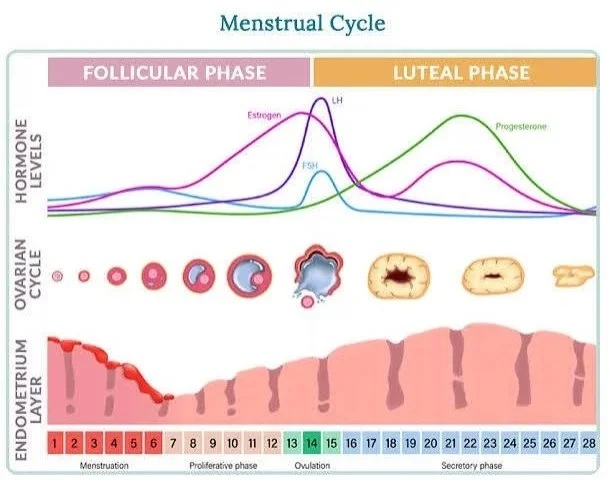
Your menstrual cycle is divided into two distinct hormonal phases. Understanding these is key to understanding how they affect your surgery.
Follicular Phase (Days 1–14)
This is the first half of your cycle, starting with your period. During this phase:
Estrogen levels are rising but still relatively low at the start, peaking around day 12–14
Progesterone is low throughout this phase
Your body is preparing for ovulation
Luteal Phase (Days 15–28)
This is the second half of your cycle, after ovulation. During this phase:
Progesterone levels are elevated (this is the main hormonal shift)
Estrogen rises again but in a different pattern than the follicular phase
This phase includes the days leading up to your period (when progesterone drops sharply)
Why does this matter for surgery? Because estrogen and progesterone have direct effects on wound healing, pain perception, immune function, and joint stability.
Estrogen & Progesterone: What They Do
Estrogen:
Estrogen affects collagen synthesis—the structural protein your body uses to build and repair tissues. Research shows that high estrogen levels (which occur during the follicular phase) can actually reduce ligament stiffness and increase joint laxity. This is why women are more prone to certain injuries (like ACL tears) around ovulation when estrogen peaks.
Herzberg et al. (2017) conducted a meta-analysis showing that estrogen affects ligament properties through direct effects on collagen synthesis. Higher estrogen levels are associated with decreased fibroblast proliferation and altered collagen formation, potentially reducing ligament stiffness. Orthopaedic Journal of Sports Medicine, 5(7), 2325967117718781.
For surgery recovery, this means: during follicular phase (high estrogen), your ligaments are more lax. If you need to restrict movement post-operatively or you're not yet cleared to exercise, this is relevant.
Progesterone:
Progesterone has muscle-relaxing properties and is associated with increased fibroblast proliferation—which means better collagen synthesis and tissue repair. This is protective for wound healing.
PART 2: When to schedule your surgery for optimal recovery
The Ideal Window: Follicular Phase
Research shows: you should preferentially schedule elective surgery during your follicular phase (days 8–14 of your cycle).Here's why.
1.Less Pain Post-Operatively
One of the most striking research findings is that women experience significantly more post-operative pain if they have surgery during the luteal phase compared to the follicular phase.
Piroli et al. (2018) prospectively studied women undergoing laparoscopic surgery and found that pain perception was significantly elevated in the luteal phase compared to the follicular phase. Pain Pract. 2019 Feb;19(2):140-148. doi: 10.1111/papr.12727. Epub 2018 Nov 15. PMID: 30269411.
What this means practically: if you have surgery during days 8–12 of your cycle (follicular phase), you'll likely have significantly less pain post-operatively. You may need fewer painkillers. Recovery could feel more manageable.
If you have surgery during the luteal phase (typically days 20–24), expect higher pain sensitivity. Your pain won't actually be worse—your perception of pain is heightened. This is a real physiological effect, not psychological.
2.Better Immune Response & Wound Healing
During the follicular phase, progesterone is low. During the luteal phase, progesterone is elevated. You might think elevated progesterone (which supports collagen synthesis) would be better for wound healing.
However, the research on luteal phase surgery is complex. Some studies suggest luteal phase has advantages for certain cancers (higher progesterone may be protective against metastasis). But for general wound healing and post-operative outcomes, follicular phase tends to be associated with better recovery and less pain.
Veronesi et al (1994) Effect of menstrual phase on surgical treatment of breast cancer, The Lancet, Volume 343, Issue 8912, Pages 1545-1547,
3. Lower Nausea & Vomiting Risk
Some research suggests that luteal phase surgery is associated with higher rates of post-operative nausea and vomiting (PONV), though this isn't universal.

PART 3: What If You Can't Schedule Surgery in the Follicular Phase?
Life doesn't always cooperate. Your surgery might be urgent. You might not have control over timing. Or the only available date falls in your luteal phase.
Don't panic. Here's what to do:
1. Talk to your anaesthetist proactively
Tell them: "I'm having surgery in my luteal phase, so I expect I may experience more post-operative pain. I'd like to be prepared with adequate pain management." This allows them to:
Plan for more aggressive pain management
Choose analgesics that work well in your hormonal context
Prepare you for what to expect
2. Increase your pain management strategy pre-operatively
Optimise everything in the 6 pillars. Better sleep, nutrition, stress management, and fitness all improve pain tolerance.
Consider asking your GP about perimenstrual support. Some women find evening primrose oil (for luteal pain) helpful, though evidence is mixed.
Plan for more support post-op. If you expect more pain, arrange extra help with childcare, meals, household tasks.
3. Consider hormonal manipulation if medically appropriate
In some cases, if the surgery is truly elective and timing matters significantly, some women discuss with their GP or gynaecologist whether hormonal contraception could shift their cycle to ensure surgery falls in the follicular phase. This is only appropriate if:
You're already considering hormonal contraception
Your surgeon and GP agree timing is worth the intervention
You have time to adjust to the hormonal change
Most of the time, this isn't necessary. But it's worth knowing it's an option.
4. Know the difference between medical urgency and convenience
If your surgery is urgent or medically necessary, don't delay it for cycle timing. The benefits of having the surgery outweigh the marginal increase in pain perception during the luteal phase. Your health comes first.
PART 4: Tracking Your Cycle for Surgery Planning
If you have regular cycles:
Simply note the first day of your period as Day 1. Count forward:
Days 1–6: Menstruation (low estrogen and progesterone)
Days 7–14: Follicular phase (rising estrogen) ← IDEAL FOR ELECTIVE SURGERY
Day 14: Ovulation (hormonal peak)
Days 15–21: Luteal phase (high progesterone and estrogen)
Days 22–28: Late luteal phase (hormones declining, leading back to menstruation)
If you have irregular cycles:
This is trickier. Some options:
Use a cycle tracking app that estimates ovulation based on symptoms
Work with your surgical team to estimate based on your typical cycle patterns
If you use hormonal contraception:
If you're on the combined oral contraceptive pill (containing estrogen and progesterone), your hormones are artificially stabilized. The benefits of follicular-phase timing may not apply to you in the same way. Discuss this with your surgical team.
If you use progesterone-only contraception (mini-pill, implant, injection), hormonal fluctuations are minimised, so cycle timing may matter less.
This blog is for medical education - please consult your medical team for clinical advice
